
A common misconception among DeFi power users is that a browser wallet’s security is only about seed phrases and hardware backups. That belief used to be useful when wallets were simple key managers. Today, however, the most consequential risks happen at the interface between your keys and live smart contracts: blind approvals, deceptive contracts, and subtle fee manipulations. Rabby’s design deliberately moves the defense line to that interface by simulating transactions and scanning approvals before you sign — and that shift has practical implications for how traders, liquidity providers, and institutions manage operational security.
This essay explains the mechanisms behind Rabby’s approach, compares the trade-offs with other EVM wallets, clarifies where the protections stop, and offers practical heuristics for US-based DeFi users weighing Rabby as a primary browser extension. Read on for a working mental model you can reuse when evaluating any advanced wallet: what the wallet prevents, what it cannot, and how to compose it with other controls.
How Rabby’s transaction-simulation model works (mechanism, not magic)
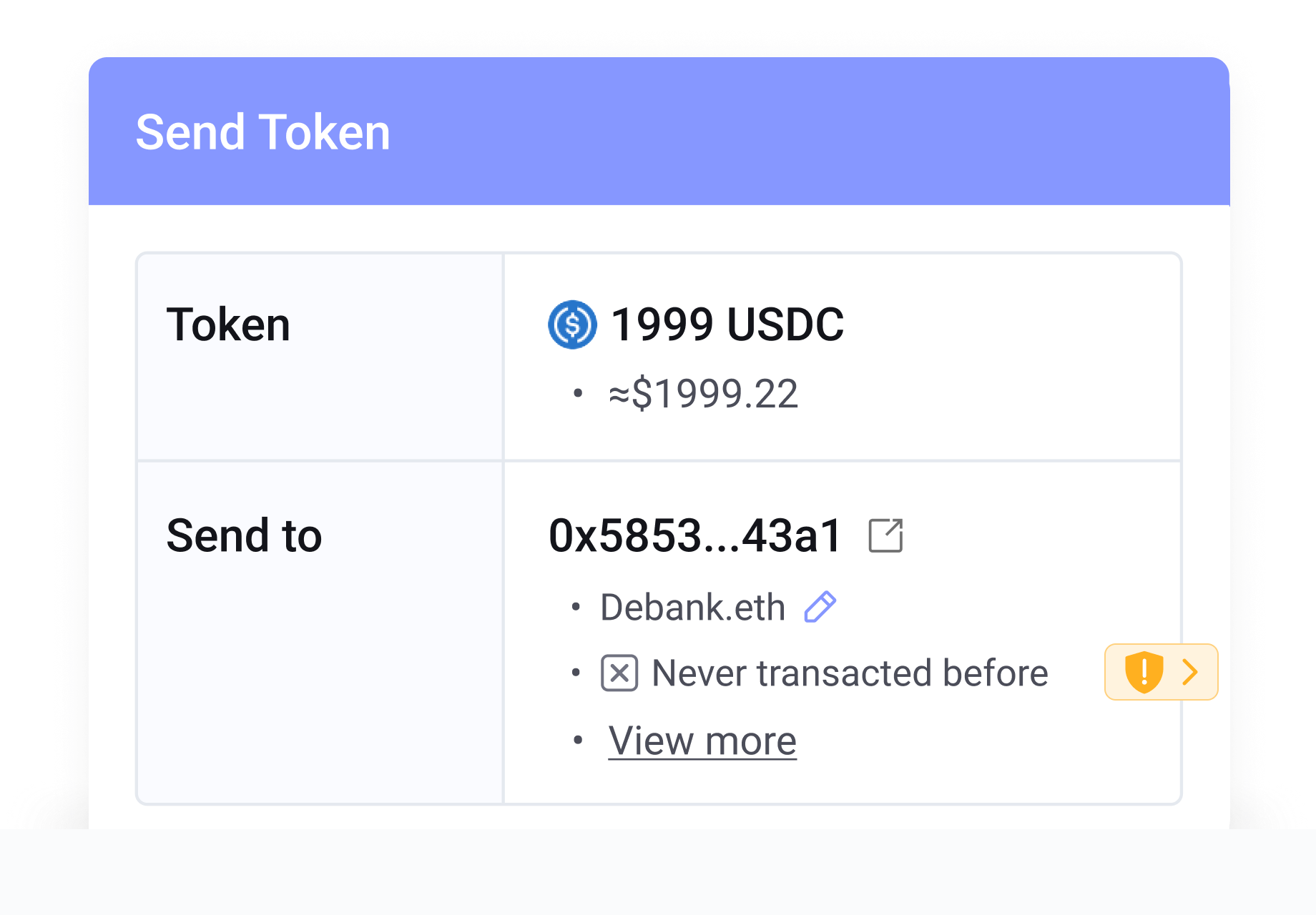
Rabby is a non-custodial, multi-chain wallet built by DeBank. Its distinctive mechanism is a pre-signing security engine that runs a dry-run of the transaction on a local or remote simulation environment and then presents a readable summary: estimated balance deltas, token flows, and an explicit fee cost. This is not just a prettified gas estimate; it attempts to reconstruct the concrete state changes the transaction will cause on the chain you’re about to use. Combined with a database of flagged contracts and a ruleset for suspicious approval patterns, Rabby produces a risk score and human-friendly warnings before you hit “confirm.”
Mechanically, simulation reduces “blind signing” by replacing an opaque hex blob with a scenario: “If you sign, these tokens will move to X contract, these approvals will be consumed, and you will pay Y in fees.” For experienced users who repeatedly interact with similar contracts, the simulation maps to a concrete expectation test: does the simulated outcome match the intended behavior? If not, the warning is actionable.
What Rabby materially prevents — and what it doesn’t
Rabby’s tools protect against several high-frequency failure modes that traditional wallets leave to the user’s vigilance.
They include:
- Detection of dangerous approvals: Rabby surfaces excessive allowance grants and offers a native revocation UI to cancel approvals, limiting exposure from compromised contracts.
- Pre-transaction contract checks: the wallet flags interactions with contracts known to have been exploited or marked suspicious by the security engine.
- Simulation of balance changes: instead of trusting a transaction payload, you see the expected token deltas and fee impact.
- Automatic network switching and cross-chain gas top-ups: it reduces operational mistakes like signing on the wrong chain or being unable to complete a cross-chain step due to zero gas.
But important boundary conditions matter:
- Simulations rely on accurate state and tooling. If a simulation provider or node returns stale state or the contract has on-chain randomness, the simulated outcome can diverge from reality. Simulation reduces but does not eliminate uncertainty.
- Rabby is not a fiat on-ramp and lacks native staking UI. Users expecting an all-in-one bank-like flow will still use exchanges or specialized staking platforms for those needs.
- Open-source code and audits are helpful, but they are not a guarantee. Past history shows real risks: in 2022 a Rabby Swap contract was exploited for roughly $190,000. The team froze the contract and compensated users, which illustrates both responsiveness and that protocol-level risk can still materialize despite good practices.
Comparative trade-offs: Rabby versus common alternatives
MetaMask, Trust Wallet, and Coinbase Wallet are familiar names and each has strengths: widespread compatibility, massive userbases, or fiat integration. Rabby differentiates itself by centering transaction simulation and pre-signature warnings. For a power user, the trade-off looks like this:
Rabby favors active defense at the UX layer (simulation, approval revocation, automatic network handling) at the cost of two practical conveniences it currently lacks: an in-wallet fiat on-ramp and integrated staking dashboards. If you need bank-like on-ramps or a one-click staking flow, Rabby won’t replace a custodial exchange. If your threat model prioritizes avoiding deceptive contracts, malicious approvals, and accidental multi-chain errors, Rabby’s features materially reduce those risks.
Another trade-off is complexity: more checks mean more onscreen warnings. That’s good for safety but can slow down rapid trading strategies. Power users who value speed should decide which layers they want automated and which they prefer manual — Rabby’s Flip toggle (which lets you switch defaults with MetaMask) and hardware wallet integrations provide options to tune that balance.
Operational patterns and composition: how to use Rabby in a secure workflow
Security is compositional. Here are practical heuristics for US-based DeFi users deploying Rabby as part of a broader controls stack:
1) Use Rabby’s simulation as a pre-flight checklist — don’t treat a green check as absolute safety. Confirm the contract address from the dApp UI, check the token deltas the simulation reports, and only then sign.
2) Keep hot and cold roles separate. Use Rabby connected to a hardware wallet (ledger, Trezor, Keystone, etc.) for high-value operations. Rabby’s extensive hardware compatibility makes it straightforward to require a device touch for signing while preserving simulation benefits.
3) Revoke approvals routinely. Use Rabby’s revocation tool after concentrated interactions with AMMs or aggregators to reduce standing allowances and limit downstream compromise.
4) For institutions, take advantage of multi-sig and custody integrations with Gnosis Safe, Fireblocks, or Amber to add process controls over high-value moves; Rabby is interoperable with these solutions and thereby fits into institutional workflows.
Non-obvious insights and corrected misconceptions
Misconception: “If a wallet is open-source, it’s safe.” Reality: open-source code is necessary but insufficient. What matters is how the wallet combines developer processes, audits, responsive incident handling, and UX that prevents human error. Rabby’s open-source MIT license and history of responding to an exploit are part of a maturity signal, but they do not remove the need for operational best practices.
Misconception: “Simulations make signing risk-free.” Reality: simulation is risk-reducing, not risk-eliminating. Simulations can be wrong when contracts rely on off-chain oracles, time-dependent state, or reentrancy patterns that only manifest under specific conditions. Treat the simulation as an oracle of intent; use it to detect mismatches between expectation and encoded action.
Non-obvious insight: for active liquidity providers and arbitrageurs, the greatest value of Rabby isn’t the occasional reversed exploit — it’s the day-to-day friction reduction and cognitive compression. Automatic network switching and explicit balance deltas reduce routine mistakes (wrong chain, forgotten allowances) that cumulatively cost more than rare but dramatic losses.
What to watch next (conditional scenarios)
Three signals are worth monitoring if you’re deciding whether to standardize on Rabby:
– Broader adoption by institutional custody providers. Deeper integrations (beyond the current ones) would lower operational friction for funds using Rabby as an enterprise UI layer.
– Improvements in on-chain simulation fidelity. If simulation engines incorporate more robust modelling of oracle-fed contracts and probabilistic execution paths, the utility of pre-signing simulation for complex DeFi strategies will increase.
– Regulatory developments in the US affecting wallet providers or on-ramps. Rabby lacks a fiat on-ramp today; if regulatory clarity prompts compliant on-ramp providers to partner with libraries like Rabby’s, that could shift its appeal to a broader user base.
FAQ
Q: Can Rabby prevent phishing sites or fake dApps?
A: Rabby’s pre-transaction scanning flags suspicious contracts and known exploited addresses, which helps when a dApp redirects you to a malicious contract. However, it cannot stop phishing sites that trick you into approving a legitimate-looking transaction you intend to sign. Basic browser hygiene, URL checks, and hardware wallet confirmation remain essential.
Q: Is Rabby suitable for institutional custody?
A: Yes—with caveats. Rabby integrates with enterprise multi-sig and custody solutions like Gnosis Safe and Fireblocks, which makes it usable as an operational interface. Institutions should still layer corporate KYC/AML, operational playbooks, and multi-sig policy controls; the wallet is a tool within that stack, not a replacement for governance.
Q: If I already use MetaMask, what does Rabby add?
A: The primary additions are transaction simulation, clearer pre-signature warnings, a built-in approval revocation UI, and automatic network switching. If you frequently interact with complex DeFi flows, those features reduce cognitive load and prevent common user errors. Rabby’s Flip toggle also lets you switch seamlessly between defaults when needed.
Q: Does Rabby support hardware wallets?
A: Yes. Rabby supports Ledger, Trezor, Keystone, CoolWallet, GridPlus, BitBox02 and others. Pairing a hardware device with Rabby gives you the simulation benefits while keeping private keys offline for signing.
Final takeaway: for US-based DeFi power users, Rabby represents a shifts-from-key-management-to-interface-defense: it makes the contract interaction visible and contestable before signing. That changes how you allocate attention and controls. But simulation and warnings are complements, not substitutes, for hardware isolation, operational governance, and conservative approval habits. Use Rabby to reduce human error and exposure; don’t treat it as an all-weather shield against every smart-contract risk.
For a quick look at the wallet’s features and compatibility, see rabby.